

Most property owners have made their peace with sales tax. You pay GST on an expense, you claim it back, and life goes on.
That reflex is about to fail a lot of people.
The Scenario
You own a commercial building in the Fraser Valley. A management company handles the tenants, a strata manager handles the complex next door, and your accountant handles the year end. In September, those invoices look exactly as they always have.
In October, three of them are 7% higher, and none of that 7% is coming back.
What Is Actually Changing
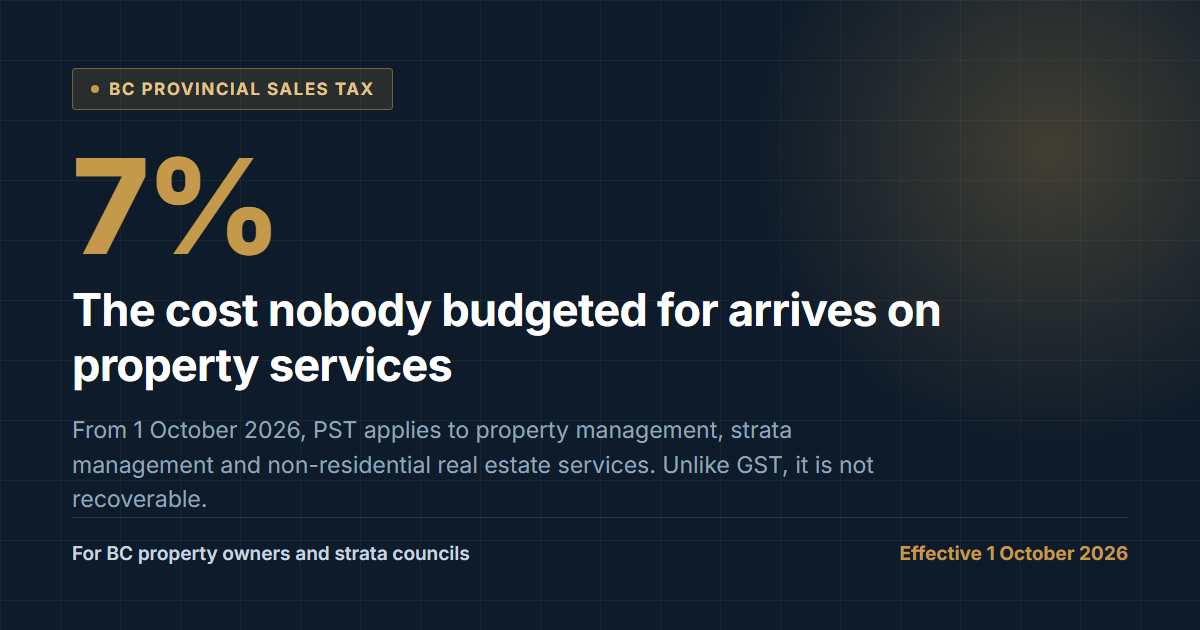
Budget 2026 extends BC’s provincial sales tax to a set of professional services. From October 1, 2026, PST applies at 7% to:
- Non-residential real estate services, including trading services, rental property management and strata management
- Accounting services, including bookkeeping and assurance
- Architectural services
- Engineering and geoscience services
- Security services, including private investigation
If you own, manage, or develop non-residential property in BC, you are likely paying for several of those at once.
Why This Is Worse Than It Sounds
Here is the part that catches people, and it has nothing to do with the rate.
GST is usually recoverable. PST is not.
A GST registrant generally claims an input tax credit and gets the tax back, so GST on a business expense is a timing matter rather than a cost. BC PST has no general equivalent. Unless a specific exemption applies, the 7% you pay on these services stays paid.
So this is not a cash-flow wrinkle. It is a permanent increase in the cost of holding and running property, and it lands on budgets that were set before anyone announced it.
On $40,000 a year of combined property management, strata and accounting services, that is $2,800 a year you do not get back.
One Detail Worth Knowing Before October
Not everything is fixed. The Province’s transitional rules leave a genuine window, and it is in the published guidance rather than being a clever reading.
If an amount is paid or becomes due before October 1, 2026, and the work is provided entirely before December 1, 2026, PST does not apply to it. The Province’s own example is an amount becoming due on September 15 for work provided in October and November, which carries no PST.
The rule runs the other way too. Once an amount is paid or becomes due on or after October 1, PST applies regardless of when the work was done, so simply delaying an invoice achieves nothing.
If you were already planning a year end, a building review, or a catch-up project this autumn, the timing of the engagement is now worth a deliberate decision. The full breakdown, including the exemptions and the rules for out-of-province providers, is set out here.
Practical Steps Before October 1
Check your budgets. Any professional services budget set before this was announced is short by roughly 7% of the affected lines.
Look at your recurring arrangements. Monthly property management and strata contracts run straight through the date by design, so they are the ones most likely to be caught mid-stream.
Ask your providers whether they are registered. Anyone selling these services has to register, and the requirement does not depend on holding a professional designation.
Watch out-of-province suppliers. If a manager or consultant outside BC does not charge the PST on work relating to BC property, the buyer may have to self-assess and pay it directly. Not being charged the tax is not the same as not owing it.
Review what a contract actually covers. Where a taxable service is bundled with something that is not taxable for a single price, bundling rules decide the treatment. It is worth knowing which side of that line an agreement falls on before it is signed.
Key Takeaway for BC Property Owners
From October 1, 2026, several of the services that keep a property running carry 7% PST, and unlike GST, that money does not come back. Between now and then there is a narrow window where timing still changes the answer.
If you hold commercial property, manage rentals, or sit on a strata council, this is worth half an hour of attention before October rather than a surprise in November.
About the author:
0 Comments